Rave Run at Lake Tahoe

By Ernest Joseph- August 2006

Search results on “races in California” resulted in an interesting hit, a race in Lake Tahoe during the time I was going to be in that area.  So I signed up enthusiastically for North star at Tahoe, a 10 K race on a late July morning at North star ski resort. Base elevation 6,330 feet.

Hmmm .. have read so much about altitude training.. thin air… lack of Oxygen… Lungs burning, and now this is the opportunity to find out firsthand how does that feel like! I wonder if this is the classical symptom of a compulsive runner? Nah, it is only a runner’s instinct to push beyond the norm, or why else would we run up the Perkins drive (base elevation 1,100 feet), or do the hook?

North star is nestled in the Sierra Nevada mountain range, just six miles from Lake Tahoe. The resort is noted for its destination appeal and was voted the West’s top third best family vacation spot by Family Fun magazine readers this year. I could see why, as we drove from San Francisco. The drive is simply majestic and of grand proportions (where else can you find pinecones the size of a football?) as you drive the Sierra Nevada mountains. Above 3000 feet elevation, the fir trees take over the Iandscape and with some peaks higher than 7000 feet, it is common to spot snow even in late July. It was for sure that the experience with nature here will be diverse and unique from the experiences of Appalachian Trails in the East.

Here is the course description:

Welcome to the North star Mountain Run.  Join us for this classic 10.6K run starting at the Village At North star and finishing at the top of the Tahoe Zephyr Express.

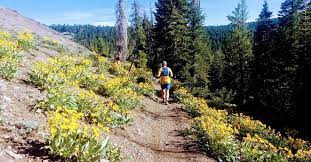
The course start smack dab in the middle of the Village at North star and quickly turns off road ascending single track and double track, offering scenic views of Lake Tahoe, wildflowers and the Sierra.

While taking in the views, racers will be challenged with gradual climbs until they reach near the top of Mt. Pluto and then contour across to the top of the Tahoe Zephyr Express.  The run starts at 6,350′, tops out at 8383′ and ends at 7894′. Bring your friends and family. They can meet you at the finish and have a fun adventure on the way taking the Gondola and Tahoe Zephyr Lift.

Temperature on race-day morning was chilling 45 degrees, a stark contrast from mid afternoon temperature when it reaches in mid 80s. While browsing through the North star village before the race, warning signs about bear sightings in the village caught my eye. Great, now as if the altitude and trail course was not challenging enough, I had to watch out for the bears!! What happens if I lose contact with the pack during the race and encounter a Bear? CouId happen. Or why else Hollywood makes film on this subject? At this point, my mind was trying to recall bear episodes from countless hours spent watching Discovery and National Geographic documentaries. I remember from one of the episodes that never try to outrun a bear. But then that was part of survival 101, and may not apply in a race situation. Now I was thinking about setting a PR, aided of course by an unintentional pacing from a bear!

About the course. Looking form the course map provided, this innocent looking outline did not tell the details like three quarters of course was rugged trail and will drop 500 feet before gradual climb of 2.5 Ion g miles to the finish line. Honestly, I did not care as I was determined to have a fun run. So much for the race strategy. Will I be able to stick to the strategy? The constant reminder of high altitude run without adjustment time and a sore left hamstring should keep me from trying anything that I would regret entering mile six in the race.

At the starting line, race director gave final instructions. Surprisingly, she did not mention bears. At this point, I was not going to ask her either. Although she did mention that “while on the trail, please do not kick dirt around, as the dust in the air will create discomfort for the runners behind you.” Interesting. Different environment, different pollutants. But if I must choose between exhaust and the dust, I wil I opt for the later. Participants in 5K run were much younger and in much greater number than the 10 K worriers. Another indication of the difficulty of 1 OK course? I could not tell.

So off we go at the modest “go” command, and within few minutes we disappear it the trail. So far Oxygen seemed plenty – although the race was only in the first mile and mostly downhill. First mile in 7: 10 minutes was according to the plan. Runner next to me at that point re marked that he needed to slow down in order to cope with the terrain that lies ahead. Pretty soon we started a gradual climb and all of a sudden the Oxygen seemed lacking. Or at least that’s what I wanted to think after all those hill workouts at home! This gradual climb never re ally ended, may be temporarily, but seemed endless until the finish. It always seems that the downhill along the course never seem to last in our memory! Well in to mile 6 and looking uphill at the finish line, I was just hanging in, trying to find ways to extract more Oxygen out of this otherwise pleasant atmosphere, Sue from Santa Clara pulls up next and declares “now you won’t let this final hill slow you down, will you?” Of course not sue. You know what? Not only will I tag along with you rest of the way, but will manage to smile at the finish line too.

Oh yes, and what about the finishing time? Let us just say I had a re ally good time.
The Female Athlete Triad

By Ernest Joseph – 2007

Recently, HBO’s Real Sports documentary series aired a segment on a silent epidemic called The Female Athlete Triad. As the name suggests, Triad Disorder is a result of sequence of 3 symptoms – a domino effect – leading to this Disorder. And contrary to the name, it can also affect male runners, although women are overwhelmingly at risk. Triad is defined as ” disordered eating” in combination with intense training leading to a menorrhea (absence of menstruation that is not caused by pregnancy or menopause) and eventually leading to osteoporosis (Loss of bone mineral density). In case of male athletes, hypogonadism (low male hormone levels) leads to Triad Disorder. In one study, the incidence of amenorrhea among women running more than 70 miles per week was 43 % (American Journal of Obstetrics and Gynecology 143 :8 59-861, 1982). Public awareness and education about Triad Disorder is limited to mostly University setting, thus thousands of runners are unaware of its symptoms and treatment.

Symptoms and Signs:

To simplify, this Disorder is a series of 3 happenings leading to Triad. [1] Combination of intense training and disordered eating which le ads to [2] either Primary a menorrhea (complete absence of menstruation by age 16 in a female) or exercise-a sociated Secondary amenorrhea (absence of 3 to 12 consecutive menstrual periods after menarche which leads to [3] Osteoporosis (Sports Medicine 78 :34 5-356, 1994).

It is important to distinguish between the terms “disordered eating” and “eating disorder.” An eating disorder is a psychiatric diagnosis such as anorexia or bulimia. In contrast, disordered eating involves sporadic eating, poor nutrition, unnecessary dieting, or occasional bingeing and purging. Ask yourself if you demonstrate any of the traits mentioned above, and be candid in your answers. One does not have to wait to develop stress fracture or repeated bone-related injuries or series of missed menstrual periods to find out about loss of bone density. By correcting eating habits, an irreversible process like Osteoporosis can be avoided and long and healthy running career can be enjoyed.

Diagnosis and Treatment:

Prompt diagnosis can lead to early treatment and a better prognosis. Prognosis is much promising for athletes under 25 years of age, because onset of Osteoporosis can be halted with reducing exercise stress, gaining weight, or Pharmacotherapy. The medical community generally agrees that bone loss is irreversible, so the concern is not only for athletes’ risk for fractures but for their lifelong skeletal structure. This means poor prognosis for women over 25 years of age. Because the Triad Disorder has been recognized only recently, it is unclear if osteoporosis induced by amenorrhea is completely reversible. Research has indicated that amenorrheic women treated with hormone replacement maintain bone mineral density but replacement does not occur (Journal of Pediatrics, 126:683-689, 1995). In theory, these women may always have a greater risk for developing hip or vertebral spine compression fractures. Also it is important to remember that exercise-associated Secondary amenorrhea is a diagnosis of exclusion; therefore other causes of a menorrhea, such as pregnancy, hypothyroidism, pituitary tumors, etc. must be ruled out before EM can be ruled in. The American Academy of Sports Medicine now recommends that aII athletes with secondary amenorrhea be screened for other components of the Triad — disordered eating and osteoporosis.

Contrary to our image of osteoporosis as a condition of the elderly, the loss of bone mass can occur by the early twenties. One cause is poor nutrition. But the amenorrheic athlete is even more susceptible. She produces very low levels of ovarian hormones, and that lack of estrogen reduces bone mass more quickly and more severely than the lack of calcium does. That is why estrogen is so widely used to combat osteoporosis in postmenopausal women.

Summary:

It is hard to define intense training in terms of miles per week. It may very from individual to individuaI. And for that reason, it is better to look out for symptoms (poor nutrition, absence of menstruation, multiple stress fractures) and act promptly. This is only an effort to make runners aware about this condition or Disorder called Triad, and by no means to discourage anyone from running. The more informed we are, the better prepared we are for prevention. And prevention is better than cure.

The Escarpment Run

By Ernest Joseph – August 2003

Escarpment trail runners, affectionately known as the mountain goats, got the opportunity to display their craziness on July 27, 2003. 2About 175 mountain goats showed up at the foothills of Windham Mountain in the Catskills, a region that was first made famous by Washington Irving through his rendition of Rip Yan Winkle.

Webster’s dictionary defines Escarpment as a long steep slope or cliff at the edge of a plateau or a ridge. The Escarpment run is aptly named after the terrain it covers in about 18.7 miles. There are three significantly vertical accents as well as descents – Windham high Peak (3424 ft). Blackhead Mountain (3937 ft) and Stoppel point (3420 ft). However, the word “Trail” is used here simply because of the lack of a better word to describe this run. The run is extremely rocky with hidden roots, loose boulders and tree branches thrown in the mix right from the start.

In every bit of the way, this run is different from any other trail runs. There are no awards or trophies, not even a T-shirt. Yes, you can earn your first T-shirt only after completion of 100 miles or 6 Escarpment runs. Tom Gannon from our club has earned this distinction this year. Even the race entry form is different – along with routine information a runner needs to provide, it asks the applicant to provide their IQ score. I claimed mine in the single digit. The race packet, which was sent out by Dick Vincent, the race director goes to extraordinary length in providing reasons why one should not run this course.

Here are some excerpts from the acceptance letter sent:

The acceptance letter from Dick reads “do to a stroke of bad luck, your entry in to the Escarpment run has been accepted.” – Either Dick has good sense of humor or he really means it. Well, there is only one way to find out.

“With nearly 10, 000 vertical feet of elevation change, mile for mile this is as rugged and challenging a run there is.” –  No argument here.

“The Europeans call this trail running as “fell Running.” – I call this fall running. There is no question Whether you will fall; it is just how hard you will fall. I had 3 falls and met someone at the Dutcher’s pass who had his hand taped to barely keep the pinky attached to his hand.

“Contestants must be prepared to deal with any of the forest’s natural barriers such as bees, slippery rock s, porcupines, black bears and anything else that can be found in the forest of the Catskills.” – Fortunately, this year nobody had disturbed a beehive like in 1987 when runners were inflicted with multiple bee stings.

“This is not a carriage trail. …..” – no kidding! There were no volunteers telling you where the trail goes and no bus to take you to the finish line in case you cannot continue. You must hike out of the trails once you start the run. At my work, there sits a plaque on my desk with these words from a poem by Robert Frost. It reads “Two roads diverged in the wood, and I, I took the one less traveled by, and that has made all the difference.”

Before the Escarpment, these words had a meaning of perseverance, but it had taken up a whole different meaning since I got accepted for the run. You see, I have a tendency to get lost on the streets with clearly marked names; so my biggest fear was to be not able to find blue markers of Escarpment trail and wonder aimlessly until I reach the sign welcoming me to Canada. But I must say that the trail is very well marked and even I was able to follow the trail without getting lost.

“The personal responsibility … . you are responsible for the costs incurred if it becomes necessary lo airlift you from the mountains.” – Few years back, our own Steve Ozer made a wrong turn on top of the black head mountain and plummeted down 20 feet or so before his fall was stopped by the bushes. He was airlifted by a helicopter, but the cost was not covered by his insurance.

“Occasional divorce is listed among complications that could occur.” –  Days prior to the run, my wife only knew that I was running in the Catskills with our friends, and no details of this run because that would have triggered endless worrying on her part. When I told her after the run, she agreed with my stated Intelligent Quotient level.

“Water …. there will be limited amount of water backpacked into few places, but won’t be nearly enough for everyone, so you must carry some water with you.” – If you have ideas of finding some water along the trail, forget about ii. You will be looking for water right up to the moment you die of thirst….. I was carrying 1 liter bottle and still had to fill it up at every station. One big sincere thank you to the volunteers who hiked up to seemingly unreachable spots carrying gallons of water. In this run, even the volunteers are of a different breed here.

“Trail Etiquette …. please let the faster runners go by you. Duh! Especially on the steep downhill, where if you fall and the faster runner is behind you, you could become a roadkill. By the way, do you know why there are trees on the steep downhill? They are there to stop your falls! I found that out on one such downhill section. Luckily, no faster runner was behind me to plaster me to the tree trunk and make me a permanent tree fixture.

Stragglers …. every year, due to injury, lack of training, or just having a bad day, we get a straggler or two.”- Well, one of the three honorees this year is yours truly. I was not 100% fit due to Bronchitis and was taking medication up to the day before the race. Due to the diuretic nature of this medication, I suffered dehydration which led to severe cramps around mile 13 (Dutchers Pass). A fellow runner provided some Sodium chloride tablets that restored electrolyte balance in 15 minutes, but I missed the cut-off at this point and had to finish hiking 4 miles via the “yellow’ trails. It was an adventure that lasted six and a half hours for about 1 7 miles. A lesson to share with you is, unlike a marathon run which can be completed by reducing running pace if you are not 1 00% fit; this run is an exception. Because the average running pace on this run is 1 5 – 20 minutes per mile and you will be spending more energy per mile than any marathon out there.

Regardless, I enjoyed various aspects this trail run had to offer, including the solitude it provides. This was a wonderful run across a wonderful country, a run in which I was able to share experience with seven other RockIand mountain goats Kathy Mahoney, Peggy Marzel, JC Santa Teresa, Tom Gannon, Pat Periatti , Steve Ozer, Steve Borton and my colleague Bronek from Taconic Road Runners. This was just about runners and mountains, and some refreshments at the finish line. It does not get any simpler than that. Now when I look at the plaque with Robert Frost’ s poem on my desk, I am glad I took the road less traveled.

Significant Event after the Escarpment Run:

Updated on August 17, 2023:

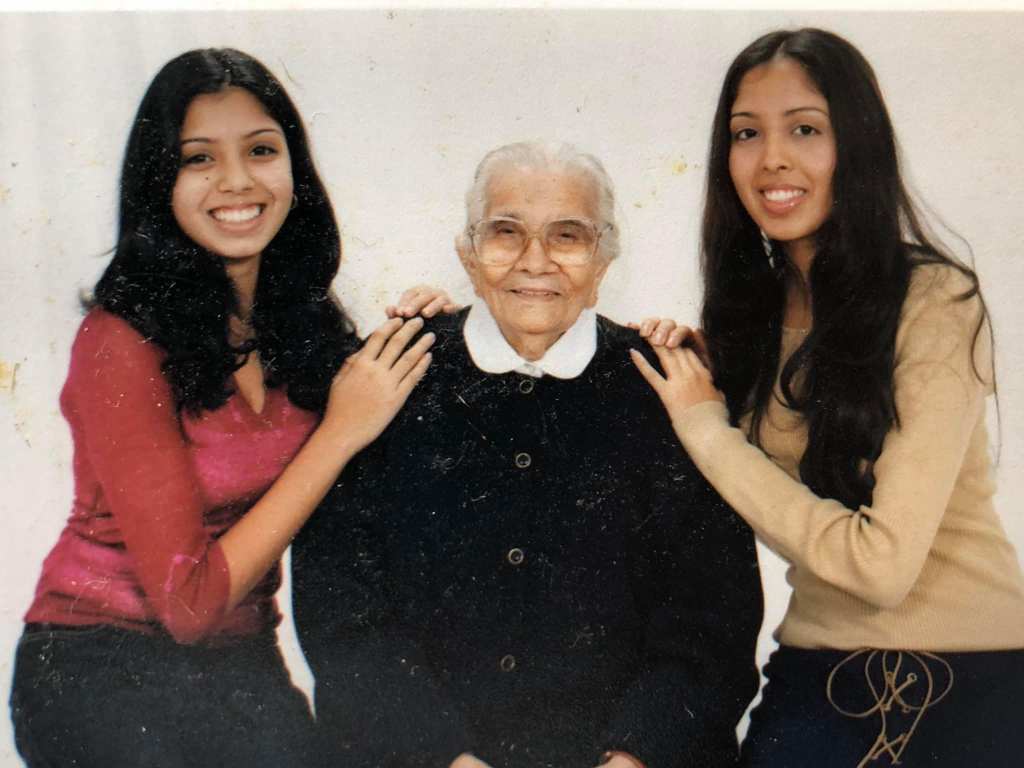
Remembering grandma Commissioner Saguna Dahya today. She would have been 116.

This event is from the same Sunday in July of 2004 as Escarpment run.

On Thursday before this trail run, I had visited her and she had no sign of illness.

On Sunday, I took off to Catskills around 4 AM to run The Escarpment trail run. No cell phone reception once we took exit for Kingston NY.

About an hour after I left for Catskills, she apparently suffered heart attack, which we did not suspect considering no cardiac history. Anyway, She refused to go to the hospital when my dad insisted. Instead, she said when Ernest gets back, we will go.

By the time I got back late in the evening, she was still fighting and insisting she is ok, just indigestion. But once I insisted, she agreed and we took her to the hospital. That’s when her cardiologist said she had suffered a heart attack. No previous history. Puzzling, but Dr said “at 97, body finds a way to move on.”

So she was fighting all day to survive until I was back. I then realized that she was waiting for me to tell her that I will take her back to Portland OR, the resting place for her late husband, where she can reunite with him.

Back in 1996, she moved to NY with us after grandpa’s passing away, but only after I promised to her to reunite her with him in Portland when the time comes.

It all clicked to me then. I then told here in her hearing aid that I will take her back as I have promised, so it is ok for her to rest in peace now.

She then reached her ear, apparently lowering volume of her hearing aid, and she closed her eyes for the final time.

This picture was taken around 2000 when we were fortunate to have her with us for her last 8 or so years of life 🥰

Trail Challenge in the Gunks

By Ernest Joseph – September 2003

Pfalz point trail challenge is a 10-11 miles trail race which was held on September 22nd on carriage trails in the Mohonk Preserve, a tiny area of the total 50 miles of network of trails that crisscrosses the Shawangunk Ridge, better known as “The Gunks” among runners.

Considered some of the finest running trails in the eastern states, the view is breathtaking and the course is considered difficult, second only to Blackhead (Escarpment trail) and Shaugeneak Hill trail races. From Rockland Lake, Mohonk Preserve is about 65 miles north on 1-87, exit 18.

I find trail running totally different than road running. I mean, I have to change my running style from long strides to small steps in order to select and secure footings and avoid falls. I have to constantly remind myself to lift the legs higher to avoid roots and rocks, and avoid falls. And I have to focus constantly within my immediate peripheral vision range to, yes you guessed it right – avoid falls. If you intend to admire spectacular views, surrounding these trails, I suggest you do it later when you are walking, or the probability of you meeting these rocks and roots up close and personal is very high.

Since most of the race is on carriage trails, at least for most part of the race, the path is 6 – 8 feet wide, with exception of the exception of first 3.5 miles and some portions between miles 7 and 8. For those who have conquered Escarpment trail run, this one is much less treacherous.

There are three sections of the races, which gives this race the high billing in terms of difficulty. First steep hill which is about half mile long, starts around 2 .5 miles in the race and rises from 600 feet to 1100 feet. Second hill starts at 3.5 mile mark and is 1.5 miles long and rises gradually from 1100 to 1 200 feet. Finally, a half-mile steep hill starts at 7.5 mile mark and rises from 900 feet to 1100 feet. My favorite portion of the race is last 2+ miles, which is downhill and in some parts even plummeting toward the finish.

About 400 runners lined up for the start. Soon after the siren, were running cautiously, in single-file, through the narrow footpath of the trail. Just before the first steep hill at two and a half mile, as we approached a mini bridge, which was actually two planks placed over a tiny creek to help runners get over without jumping, it seemed safe to run on its surface. Well, we were wrong.

One runner in front went down and soon there was a pile-up. This was at the bottom of the hill, so for next few minutes, until we reached the top, the very quiet surrounding was disrupted by occasional screams coming from the runners who were just experiencing their first unexpected fall.

My problem was different. I had just started to walk this steep hill. There were runners of all sizes, shapes and genders passing by. I kept convincing myself that my approach is the approach an ultra-runner would take to conserve energy. Well, in reality, this was not an ultrarun and I just was not able to “run” the hill as well as these passing runners. One guy gave me a pat of encouragement on my back as he passed me. Once over the hill, I started to run again, and recognized some familiar backs as I passed them going downhill. At the second hill, which was 1.5 miles long but not as steep, again some of the familiar faces started to pass me, including this guy. By this time we both knew the pattern. He runs hills better, and my quads could take the downhill better. Well, we knew enough about each other, and it was about time to introduce ourselves.

He said his name was Mark and lived in nearby Gardiner and he runs these hills all the time. I said I am Ernie and I will see you on the downhill. We played this battle one more time at another significant hill at seven and a half-mile mark, before I barely placed ahead of him at the finish.

After the race, runners gathered at the scenic Singerland Pavilion for awards ceremony and the “chili feed.” Proceeds from the event go to support the Mohonk Preserve in its mission of protecting over 6,400 acres of the Shawangunk Ridge. Design of the commemorative T-shirt is cool, but Iimited to first 200 pre-registered runners. You can buy it for $10, which is still a good value and helps preserve these precious trails.

Running and Heart of the Matter

July 10, 2021

It was Saturday March 22, 2015. Day to run Sleepy Hollow half marathon in this sleepy town which was made famous by Washington Irving and his writings of short stories such as “Rip van Winkle” and “The Legend of Sleepy Hollow.” This was supposed to be my “comeback” to race of longer distances in a hope to revive my rather slow running status since past few years. I was reasoning my slow running with my old age of being 59 and not a spring chicken anymore, not enough training and no speed workouts. All these seemed obvious reasoning at that time, because it never entered in my mind that I could be having health issues. I thought, after all, I am a runner, fit and healthy – I am invincible!

The half marathon course is hilly and goes down to the banks of Hudson river and back up through the town. I was not feeling right that day – my chest felt heavy and could not breath easy. I thought it must be that lingering cold I am trying to get rid of since last few days is impacting my performance today. But as the race progressed, I was getting more and more uncomfortable and started to walk and run during last 4 miles or so. I finished in time of around 2 hours 20 mins. This is the first time my half marathon took me over two hours! Yet, I was happy that I was able to finish and soon I will feel better and can run faster times during upcoming spring and summer races.

Five days later – It was Friday March 28, 2015. I woke up at 5 AM with heaviness in my chest, and difficulty breathing. I proceed to take shower, hoping to go to work, bring my computer home and work from home. On my way to work, I stopped at Dunkin Donut shop as usual and started to head to my work. As I came near Nyack Hospital, something inside me told me to go to emergency room and get checked out. So Instead of going over the Tappan Zee bridge, I tuned in to the emergency room.

I was hooked to EKG machine right away, and within few second, they took me off from EKG saying “Sir, you are having a heart attack and we will have to transfer you to Good Samaritan Hospital (half a marathon distance away) right now. They started prepping me up for the transfer, shaving my chest to make me ready for the cath. Lab.

It was still not hitting me as this being a serious event. It was mainly because I was not having sharp chest pains as I have seen in movies being portrayed for heart attack scenes. So, while I was waiting for the ambulance crew to arrive, I first called my manager’s landline to let him know I will not be in the office, but will see him on Monday instead. Then I called Anju to let her know to come to Good Sam hospital where they are taking me because I was having a heart attack. Knowing her worrying nature, I assured her that it is a mild one and I should be fine. When I told this to my co-workers a year later, they said I was a workaholic! I said why? The response – Because I called my manager first and then my wife!

Although it was Friday morning rush hour, the ambulance had its sirens blasting and lights flashing, it was relatively fast transfer. As I was rushed into the cath. lab., the staff was uplifting me with cheering words like “you are now in the place where we will take care of you”

Dr Arvind Agarwal was on duty. I know him personally because he treated my parents. Although Dr. Shridhara was my cardiologist, they both are part of the same practice. I felt relived that Dr. Agarwal will have my history charts soon and he all will be fine.

I started talking to Dr Agarwal by saying “Dr., please fix me well because in few months (Dec. and April) I have to walk my two beautiful daughters down the aisle” Dr. was not interested in talking to me but started catheterization process right away after watching the monitors for my heart condition.

After inserting one stent into my left anterior descending artery (LAD), he said “your artery is totally, completely blocked. But this stent will now open up the blood flow and you should start feeling ease in your chest and easy breathing.”

I was having a widow-maker event! The widow-maker is a massive heart attack that occurs when the left anterior descending artery (LAD) is totally or almost completely blocked. The critical blockage in the artery stops, usually due to calcification, stops all the blood flow to the left side of the heart, causing the heart to stop beating normally.

As scary as this was, I started to wonder why was this not picked up during my visits to Dr. Shridhara? While I was passing stress tests, my artery was getting clogged due to increase amount of cholesterol level in my body. I was not following his instructions to get on statins, thinking hey, I am a runner, and I can control my cholesterol by running and no need to take this medicine which will make me cramp during my runs – the major side effect of statins which I was aware of, and I did not want it to hamper my running.

Dr. Agarwal said my overall fitness played a big role in my fast recovery and ability to withstand the trauma. He said we will work slowly toward running again. I may not post seven-minute miles anytime soon, but I can get back to light running soon. He says beyond that is a negotiation.

I think it’s a nice way for him to say, ‘We’ll see.’

I now have a defibrillator implanted in my chest to shock my heart back into rhythm if it goes into sudden cardiac arrest – a condition of my heart due to massive heart attack that caused ejection fraction dropped from 75 to 45. It was uncomfortable in the beginning, but oddly, I don’t even notice that it is there. I feel more content and at peace now than before my incident. And best of all, I am alive and have full use of my arms, legs and vital organs. The docs wanted to make sure that if my heart ever goes into fibrillation due to low ejection fraction, then it’s there and it will kick in and provide shock to my heart to kick-start it again.

I am sharing this experience with you – and specially with my running, biking, swimming friends – so you can relate to, and may help you not take your health and condition for granted.

Six year later, I am 65. I do have a family history of heart disease. My dad had a stent put in by Dr. Agarwal 20 years prior, and my mom had undergone quadruple bypass surgery. I’ve heard plenty of tragic stories. I was at the Olympic Marathon Trials in 2007 in the Central park volunteering at a water station when Ryan Shay died, the highest profile heart related fatality in our sport since Jim Fixx, who helped launch the first running boom, dropped dead on a run in 1984. Jim Fixx suffered a heart attack at age 52 while on a run in Vermont~ An autopsy revealed he had serious blockages in all three coronary arteries. Ryan Shay, died as a result of structural defect known as heart scarring. He was only 28.

In most recent memory, Alberto Salazar, suddenly and shockingly, he was felled by a heart attack on June 30, 2007 that nearly killed him. As the news flashed across the Internet, the running community felt spasms of fear and disbelief. How could this happen to a former distance star who had won three straight New York City Marathons and was still young (48), trim, and running 25 to 30 miles a week? Runners hadn’t felt this spooked since July 20, 1984–the day Jim Fixx died while running in Vermont.

Every time I think about it, I can’t believe how blessed I am that this miracle took place. It’s very sobering. For a few days after the event, I was going to sleep at night wondering, “Am I going to wake up in the morning?” We take waking up every morning for granted, right? I don’t anymore. And it is even harder for my wife, when I am either traveling for business or we are apart overnight. Before the heart attack, I never texted her “good morning” from Germany, Spain, or wherever I was on this planet, but after the event, I make sure that the text is the first task I perform to let her know my heart is still ticking. It’s a peace of mind for her.

Now I’ve gotten over that and moved on to the reality of my situation–knowing that I’m going to face this again, maybe from my heart, maybe not. Maybe I’ll see it coming, maybe I won’t. But it’s going to come again. And that makes you think, Are you prepared? It forces you to delve into every part of your life. You think about things you’ve put off, regrets you might have. You begin to ask: Do I have some unfinished business? Have I let old disagreements get in my way? Have I left certain words unspoken to my brothers, father, sister, friends?

And it makes you think: You know what? I’m going to take care of all this stuff now. I’m going to start crossing things off my list. I feel so lucky that this happened, because now I see things much more clearly.

Here is the thing: Before this, I went to my doctors, but ignored their prescriptions of statins because I was not willing to let that affect my running performance. I thought I was invincible. I’ve asked a lot of my running friends and found this kind of thinking in athlete’s mind is not uncommon. I think everyone should get checked out regularly, even if you feel totally healthy like I did.

I don’t think anyone should be scared. I think you should be aware. That’s why I’m talking to you about what happened to me. Runners need to know that it can happen to anyone, even if you’re in great shape. They need to check their blood pressure and cholesterol, and to know their family history. And if anyone’s really worried, they should consult with their doctor and consider an exercise stress test.

Hope this is helpful.

New Jersey Shore Marathon 2004

This image has an empty alt attribute; its file name is jerseyshore2004_1.jpg

  • By Ernest Joseph – April 2004

Have you ever been in the situation where you are just feeling so good about your marathon run and can’t wait to tell everyone about it? Well, I am not only feeling good, but I am ecstatic about the Jersey marathon on April 25th. The day was perfect, unlike last 3 years in a row when it had rained hard and strong wind was in our face all the way. There was some strong wind this year, but coming off the ocean and not in our face. I met up with Steve Joseph before the race and with Debbie and Shawn at the start. This was Herb Conrad’s first marathon at age 58 and Steve told me later that he looked good around mile 21. I am not sure how many were in the race, but it seemed close to 2000 for the marathon. My goal was to run 3:30 marathon and Steve was shooting for 3:45. Herb was in a win-win situation of running his first marathon and setting a PR.

First mile was in 8:15, which was our plan. Reached 10K in 48 min. (7:45 pace). Felt very relaxed and not pushing at all. Reached Half in 1:41 (7:45 pace). I was constantly checking the time every mile to make sure I do not go out too fast. At this point, I met up with two runners who were running interesting pace for a 3:30 marathon. They were running every mile at 7:30 pace, and at the mile marker they would stop and walk for 25 sec. I guess this way averaging 8 min. pace per mile for 3:30 marathon. I wonder how they did. I passed them soon. The next 7 miles I must have picked up the pace a little because I reached mile 20 in 2:33 (~ 7:40 pace). At this point the memory of NY came to mind, where after 23 miles I had started to cramp badly. No such mishap to report this time around. I felt strong and must have picked up 50 or so runners in next 6 miles before reaching the finish in 3:23 something. I was within a minute of my best time of 3:22 on the slightly different course in 2000 when the race was called Jersey Shore Marathon. I was happy to run the “textbook” marathon – first half in 1:41, followed by 1:42 second half.

And to top this effort off, I also scored a personal victory. At mile 25 or so, I saw this distinct neon yellow shirt of GNY team. As I started to gain on this runner, I realized that I was chasing Julio Aguirre. I have been chasing this 57 years old (and 9-year senior to me) unsuccessfully for ever in the Central Park races where he usually tops his age group. But today, I had his number. It took me 25 miles to chase him down. Most likely he will restore the order when we resume in the Park, but for once, it just felt so good. (Three weeks later Julio ran Queens half marathon in 1:25 on a hot Sunday).

Steve Joseph ran 3:41 (well within his goal of 3:45) and he was generous to share facilities at the motel with me (no Jeff, we ran together, not showered together). Herb Conrad ran his first marathon in 4:16 and he is satisfied with his time considering the first one at age 58 and happy with the experience. Few days later Herb commented that “Now that my legs and body have actually recovered, training for the fall marathon starts. I don’t know why, but I just can’t wait to go through this pain again. I am afraid I am becoming addicted.”

If there is a marathon, then you can bet there is going to be a runner in costume. Around mile 20, I saw someone running in a long blue dress about a minute ahead of me. I could not catch up with her, but after the 21-mile turn around point, I had a closer look. This was a young male cadet (I assume from the West Point Academy). When I said he looked great (and I meant his running form), he replied with a signature response of “thank you, sir.”

Overall, a very satisfying day and for a change something other than cramps, hot weather and bonking to talk about.

Choices we make

By Ernest Joseph – 2002

2006 masters Challenge

In life, for every decision we make, we are faced with at least two choices. It is the choice we make that defines our future. At least that is what my uncle used to say. But sometimes we are faced with a decision that offers tough choices. And in these cases, our ingenious mind come up with a plan called balancing act. Balancing work and family life, finding a balance between tasty and healthy food, finding a balance between carbo loading and protein intake, finding balance between long runs and speed work, even finding balance in our lives through running. And last but not least, finding balance between running and family life. For most people, the problem is finding enough time to exercise. For runners who run and train for a race, the problem is finding enough time to do anything else.

One Saturday morning on a pump house run at Croton Dam Reservoir, a friend explained to me why he has stopped running races for his club. Few years ago he was faced with a decision to either run in Milrose games or take his son who was in pain to the dentist that morning. On one hand, club was counting on his commitment, after all, how often one gets an opportunity to run in Milrose games? On the other hand, he was worried about unexpected emergency, although his wife had reminded him of her competency in handling any crisis. While he chose to honor his commitment to the club, the visit to the dentist turned out to be an in-hospital surgery. Although all went well in the end, he could not forgive himself for being not there for his son.

Every runner faces decisions and choices. Sometimes choices we make seem amusing and other times solemn, but these choices keep circle of life going while making everyone involved happy. There is a reason why the phrase “runners are different” exists! Following are real life examples of some of the many balancing act performed by ever-creative runners.

How often have you run very early in the morning in the dark or late in the night and sometimes with a miner’s light on your head to guide you, just so that you balance between family obligations and required weekly mileage? And while doing that, how often have you sneaked out of the house so that you would not disturb the sleeping family? And listen to this one, you had convinced your spouse that all these running is for the upcoming fall marathon, but the marathon has come and gone, and still there is no sign of you slowing down! After Boston marathon in April, my wife asked me if I was going to run Boston again. My reply was empathetic no. Her skeptic look turned in to an investigative look and like a seasoned psychologist she said, “Now I know what it is like to run a marathon. It is just like us having a baby. We say no to having another baby right after giving birth, but soon we forget about pain and start thinking of having another one…”

Or how about a run between daily chores like dropping kids off to school and picking them up?

Have you planed a vacation around a marathon with your significant other? It better be in Bermuda, Paris, London, Hawaii or Disney World, but definitely not at Jersey shore. After all it is not about the PR course, it about a vacation spot everyone can enjoy.

Have you ever thought of asking a fellow runner if it is OK for you to use his mailing address to order running shoes, a second purchase in last six month, worth more than 100 dollars of course, because you can not seem to find a winnable argument to justify the need of the new shoes to your spouse?

Breaking barriers is about making choices. Have you ever made that difficult decision to move from one group of runners you have had countless fun run with to a faster group so that you can train for your PR race?

Have you ever consider a change in your race strategy in the middle of a marathon so that you can help friend achieve her goal?

And how about choosing between that all-important race this Sunday and the church service? Once, noticing my frequent absences on Sunday, I was asked by my pastor what religion I follow lately? Remembering a line from Doc Sheehan’s article, I replied, “I used to be a Methodist, but now I am a runner.”

Alright, enough about this amusing stuff. Life is all about making choices. It’s important that, as hard as some of them may be, we make those choices and take those decisions. Never be so afraid of making the “wrong” decision. If it turns out to be wrong in hindsight, well, you did the best you could at the time. Correct what you can and move on. When you’re faced with a choice, remember that it’s better to make a decision – any decision, like those balancing acts – than to stand there and be run over by the train.

2007 Boston Marathon Memories

Compiled by Ernest Joseph

Boston 2007

So here we were, couple of days before the Boston Marathon; with our jaws wide open in disbelief, reading this weather forecast of an imminent nor’easter. In the beginning, we kept saying “it is always a 50-50 chance with these forecasts, so with our luck, it is going to be a great day in Bahstin on Monday…”

By Sunday, the day before the Marathon, we were getting a surreal preview of the weather we will get in Boston on Monday, as we prepare to depart for Boston, and needless to say, it did not look promising. But we had our own RRR hotline created with cell phone network, trying to help each other out. Gokhan Ozuner was supposed fly at 8 AM, and somehow his flight took off in that crazy storm, thank God. But Jim Dangler was not as fortunate, as his flight was cancelled. With some quick phone calls, Jim was able to get a ride with Jerry Sun and Mike Nusblat at 10 AM that morning. Kathy Daly called and asked if she and Grandma will be able to get a ride back from Boston on Tuesday. With our networking, nothing was impossible. Everyone was accommodated. In between, we were getting calls from our concerned RRR friends and families who were on the BAA website, monitoring latest developments. Everyone was concerned and worried about possible hypothermia and other health risks. Special concerns were for Grandma Marie Killeen, but if you know Grandma, you know that it would take a hell of a lot more than a freakin’ nor’easter to keep her away from that famous starting line! Grandma has seen enough in her lifetime to know when to back off, and this was certainly not the one to even reconsider dropping out. Our commitment was unwavering.

A sign I saw at the Expo says it all – Reason number 4321 to run Boston: “My boyfriend said I am afraid of commitment, I had to prove him wrong.”

As we were driving or flying to Boston, we kept calling each other to keep everyone updated. Gokhan, who is a medical doctor, had offered RRR members a bus ride on marathon day through his American Medical association, that will allow us to stay in the bus; dry and warm, until the race starts! Wow, we thought life does not get any better than that! Not only that, our bags will be brought back to the hotel, and so we did not have to wait for our baggage pickup after the race! Thanks Gokhan, your help was greatly appreciated and as we can see now, it is reflected in everyone’s performances 🙂

Patty and Shaun Daly, Kathy’s parents were also traveling with us, and Patty offered to book a nice restaurant for all of us that evening. To reserve a dinner spot on Sunday night before the marathon in downtown Boston is almost impossible, but do not tell that to Patty, as she had us reserved at Stephanie’s on Newberry and Exeter intersection, just couple of blocks away from where we all were staying near the Copley Square. Thank you; Patty and Shaun, for your company on Sunday night. During the course of the dinner, our conversation ranged from past experiences to the strategy for the race day. Shaun Daly, who has run 3:10 marathon in the past, had some nostalgic stories to share about Dublin Marathon, where Kathy’s grand father had finished second overall once. Kathy proudly displayed that medal and said “I will wear this medal tomorrow as a good luck charm….”

During the dinner, my cell phone rings, and it was Josephine Patten on the line, telling me regretfully that she will not be at the start line. Josephine has been running phenomenally, leading up to the Boston, but a bout with bronchitis and then an unfortunate fall during a training run in the trails had left her with a knee that required some stitches. Josephine tried to test her self out on Saturday at Brooklyn half, two days before the marathon, to see if she can run Boston. She did well in the half, with a time of 1:40, catapulting the 40+ women’s team to a victory which would not have been possible without her. But during this race, she felt enough discomfort in her knee, resulting in her decision not to run on Monday. Wise decision Josephine, you have done Boston four times before, and although we would have loved your company, please note that you were one of the inspirations to us all on that Monday morning. Talking about inspirations, constantly on my mind  were my RRR friends who had worked hard all summer in 2006 and finally qualified for Boston but injuries kept them away. Alisa Carbone, Mitch Pollack and Kate Tormey had run perfect race at Steamtown to qualify, but they must wait for another year, heal from injuries and come back strong in 2008. As a runner you can just imagine their frustrations. I kept telling my self “tomorrow you are not just running for your self, you are representing your training buddies, and so go out and make them proud…”

As we depart from the restaurant, the rain was coming down hard, with a wind gust of 50 miles per hour. Umbrellas were not as useful, but we were optimistic, that tomorrow morning these all scary ailments will go away…

But we had to spend the night before we can see tomorrow, and the night was not moving forward any faster for some of us… Jim was talking about the wind gusts and the rain banging on his window all night, keeping him awake. I am a deep sleeper, and so I was spared with this anxiety during the night. You can have a parade of elephants go through my room, and chances of me waking up are very slim. My wife Angie, on the other hand, is a light sleeper like Jim, and she confirmed high winds and rain throughout the night.

Marathon Monday

On local Boston TV, they were calling it “Monsoon Monday,” and in the early hours of Patriots’ Day that was as good a name as any. Torrential rains soaked southern New England, while ski country in Vermont got more than a foot of snow. Wind gusts up to 50 miles an hour buffeted volunteers at the finish line in Boston as they toiled just after dawn. Could the race really go on?

Of course it can. After all, in it’s 111 years of history, the race was only cancelled once, but not due to extreme weather. In 1976, race time temperature was 96F, and the race went on, and who can forget 2004 Boston in 85F! So, the BAA was able to convince the Boston authorities by saying “If you decide to run it, we guarantee that they will come.

And that’s what precisely happened. Over twenty thousand entrants showed up for the dance.

Kate Devine, Jim Dangler and I met up in the lobby of The Sheraton at 5:45 AM to go to Gokhan’s hotel, which was one block away. When we ventured out, the wind was blowing from all directions, and the rain was piercing. But I had this optimistic answer to this situation: I said “the weather is always at it worst when the day light is about to break….” And it seemed that Jim and Kate bought my optimism for now as we entered the Hotel Colonnade. Kathy and Grandma joined us soon, and we were off to the athlete’s village in Hopkinton by 6:30 AM on the American Medical Association sponsored bus.

About 45 minutes later, we arrived in the village. Our bus was parked in a permanent place, and we were allowed to stay on the bus till our start times. Meanwhile, the nor’easter was in full swing outside. We had about 2 hours to spend, and we were so thankful that we will not have to spend this time out in the open, with 20,000 runners, on a muddy, rain soaked grounds. Occasionally, we went out to go to port-a-John, or just got out to get a sanity check. You see, we were so warm and comfortable inside, we would think of wearing shorts and singlets, until we go out and get a reality check. Jim and Kate kept mentioning of wearing shorts, and every time they mentioned, we would send them out for a reality check. They would come back in the bus and say: “definitely tights, and no shorts.” Thankfully, we all dressed wisely, and as a result, performed so exceptionally well. Hypothermia was THE common cause for runners for dropping out in last miles of the marathon, and it was caused by high winds and cool temperatures, resulting in to cramping and seizing muscles, making it impossible to move forward.

At one point the bus coordinator announced “we will be leaving right after the race starts. Who is going back?” Of course he was referring to “supporters” who had come to see their runners off at the start line. Quick witted Kathy Daly replied “Oh, I did not know we had that option…” All this humor and laughs kept us relaxed and took our minds off the weather temporarily. We made friends with Brian from Utah, Christine from Oregon and Allu from California. These physicians were attending the conference and today they were ready to tackle the course. Couple of them had taped the top part of their sneakers with a duct tape. How clever! Brian said he will take the tape off before the start, and it will allow him to stay dry until the race starts. We asked them if they had instruction sessions on “Boston 101” during their conference, in between the heart and brain surgery lectures.


Running with the silent spectators – by Ernest Joseph

As a runner, traveling abroad makes us realize that running has its own culture and it varies from one country to another. I found running in the streets of European or Australian cities not much different than running in the United States. On the other hand, running in the streets of eastern civilization can be entirely different story. On my recent visit to India, my place of birth, I found it to be true. I did not know how the experience of running in the streets will turn out, partly because it had been 18 years since my last visit to the land of enchantment. I had avoided running as a fitness activity as a youngster in India, although I had participated in sports at university and state levels. But there was one thing I was sure of – although running in places such as tracks and parks is gaining popularity in India, running in the streets is unheard of and will raise few eyebrows. Keeping this in mind, I ran on treadmill in Taj Hotel while I was in Bombay, the largest city in Western India. I was delighted when I saw 1.0 displayed next to “distance” on the control panel and time was only 4:15 minutes! I thought I have improved tremendously on my mile PR until I realized that the distance was in kilometers. For a moment I thought it had something to do with “jet leg(s)” from 20 hours of flying! My next stop was New Delhi, the capitol of India in the northern part. Keeping safety in mind, I asked at the front desk of the hotel about running in the streets in the early morning hours. His polite response was “sir, you should not run in the morning because it will be very cold outside…” Well, It was in the Fifties next morning, but was considered a cold wave in a place where the average temperature most of the year is in the 90s. I told him about our Saturday morning runs in sub-zero temperature at Rockland Lake in the winter months and I am sure he must have thought that I was crazy.

Finally, I found a perfect setting for an outside run. This was at Mount Abu (1219 Meters). It is a pretty hill resort in the State of Rajasthan in western India and famous for it’s exquisitely carved Dilwara marble temples. It is a well-known fact that the art & architecture of a country reflect its intensity of religious devotion as well as economic prosperity, without which elaborately carved temples such as Dilwara could not have been raised. In every phase of Indian history, Kings and Princes supported art & architecture by spending lavishly on the commemoration of their religious beliefs or personal interests. The first of these ornate temples dates back to 1032 AD. The temples of Dilwara are an absolute “must” for anybody visiting India – perhaps even more so than the Taj Mahal, a more publicized 17th century symbol of married love.  Even my 16-year old shared this opinion by saying “I will nominate this temple as the eighth wonder of the world.” Such a masterpiece of temple architecture with intricate carvings on marble stones, which were brought up to such high elevation on elephant’s backs in 1032 AD, is worth a trip to this remote place.

The plan was to start my run from this 125 years old princely club with polo grounds which is now turned into a luxurious Rajputana resort, and head towards Dilwara, about 5K distance. Since the run was in the morning, I was expecting traffic free tranquil run. But I knew I was going to have company of the silent spectators, called Presbytis entellus, AKA Langur monkeys. Langur in Sanskrit means, “tailed”. Countless groups of these long-tailed monkeys inhabit the tree-lined roads of this resort town, and despite being a folivorous species, I was told that “hand- outs” from people as well as “snatch away” from people also constitute a large portion of their diet besides foliage. In other words, I will be fine as long as I do not carry food or water on this run. During my run I constantly felt this friendly human-like presence but with an awkward silence. It’s like running NYC marathon with silent spectators. Come to think of it, I had run NYC marathons in the eighties where I had found few sections of the course (and I am not talking about the bridges) with silent spectators, but glad to say that I found them vocal and involved during more recent runs. Anyway, I did make occasional eye contact with these silent friends and as a response I got occasional whoops form them, but mostly they seemed busy in their social grooming activity.

Overall, I was thrilled to get a run in and did not have to worry about safety or dress code (shirtless runner in Japan breaks the local law). Running in most parts of India is confined to Tracks, Parks and Beaches, so there are no road races. There are couple of marathons that take place per year but without mass participation. The only social running club I was able to find was Harriers in New Delhi, but their focus seemed to be more on drinking than running. India has plenty to offer for a curious mind which is willing to go with the flow and look beyond the startling socioeconomic gaps. When I asked this guy I met in Agra hotel who was from Boston, about his visit so far, to which he replied, “I am here only since two days and it seems like I am here for months…. too much to grasp at every step of the way…”

Marathon Memories

by Ernest Joseph

According to a Chinese proverb, the palest ink is better than the best memory. And according to Barbara Kingsolver, author of Animal Dreams, memory is a complicated thing, a relative to truth, but not its twin. So when a runner reflect back on the past marathons, there are events and incidences that come back with great clarity and detail while some events are foggy. Then there are mostly fond memories and some melancholy moments too. But thank heavens for short term memory, otherwise I would have stopped running marathons right after the very first one. The advantage of a short memory is that one relives the same thing – like hitting the wall – over and over again as if it were happening for the first time.

Runner’s interaction with spectators is unique to a marathon. My favorite is giving high-fives to the kids. Extended arms along the course seeking high-five are not uncommon, but there are these tiny arms way below the runner’s eye level that gets my attention. One common expression I notice on these kids’ faces is of happiness. A simple high five can encourage their happy souls and may ignite a passion for running.

In return, spectators get involved by means of message signs. I enjoy reading signs raised by the spectators. Some signs are inspirational while some can simply make you smile. In 1999, a sign just before Queensboro Bridge read “Pain is temporary, pride is forever.” In 1986 at the Willis Avenue bridge around 20 miles, a huge banner read “Walls do have Windows”. In 2003, a sign somewhere in Brooklyn brought laughs from the runners which read “Run like her husband is coming.” An advertisement had these inspirational words along the course of NYC marathon: “Sometimes you start with your legs but finish with your heart.”

Talking about finishing with a heart, At 2000 NYC I came across a 47 years old former track stand out from Canada named Bruce Trigg who despite of severe groin injury at mile 6 managed to finish the marathon in 2 hours 58 minutes. As a 25 years old in 1978, Bruce had finished NYC in 2:36. He could have easily dropped out after injury as he did not have to prove anything to anybody, but he chose to finish because finishing this reunion-marathon with his 1978 buddies was important to him.

In 1989, running alongside this runner from California in Central Park, I commented that there could be nothing tougher than the last few miles of a marathon. She shot back with “Oh, yes there is. Labor before giving birth…….” I guess memories of marathons and labors are stored under short-term memory compartment of the brain.

After 1986 NYC marathon at the family reunion area, first words out of my then 5-year-old daughter’s mouth were “Dad, what took you so long?” With that came one of the early lessons of her young life: The importance of finishing something that you start, no matter how long it takes.

At 2001 Boston, I came across a runner with this inscription on her back: “I may have the looks of an angel, but I run like hell.” Hell’s Angel she was, I suppose. And who can forget the screeching women of Wellesley and adrenaline pumped runners doing pushups in response.

In 2003 NYC, after reaching mile 23 in 3:02, I spent next 40 agonizing long minutes in the Central Park before reaching the finish line. This definitely was a melancholy moment. Friends still tease me with “what happened in the park, did you stop for a hot dog?”

Then there was this guy at Jersey shore marathon in 2000 and 2002, stationed around mile 2 or 3 offering beer to the runners! Next time I see him, I will tell him to be at mile 23 and I might take him up on his offer.

Whenever I volunteered as a course marshal for the NYC marathon, it has rained. My usual assignment is at the last mile of the marathon. At this spot, the crowd is made up of out-of -towners whose loved ones are running the marathon, so the questions you get from them requires you to be a multi lingual tour guide. Once the race starts, the excitement builds. Once the helicopters are hovering above you, that means the lead runners are in the park. Between 4 and 5 hours, thousands of runners pass the finish line. Each one in different form, some sprinting while some are stragglers, but all seem revived at the sight of the finish line. No one complains about the last cruel climb to the finish line.

Remember that show Wonder Years? In one of the episodes the narrator say “memory is a way of holding onto the things you cherish, the things you are, the things you never want to lose. “ May be that is the real reason for a runner to keep coming back to marathons after swearing not to do one again.